
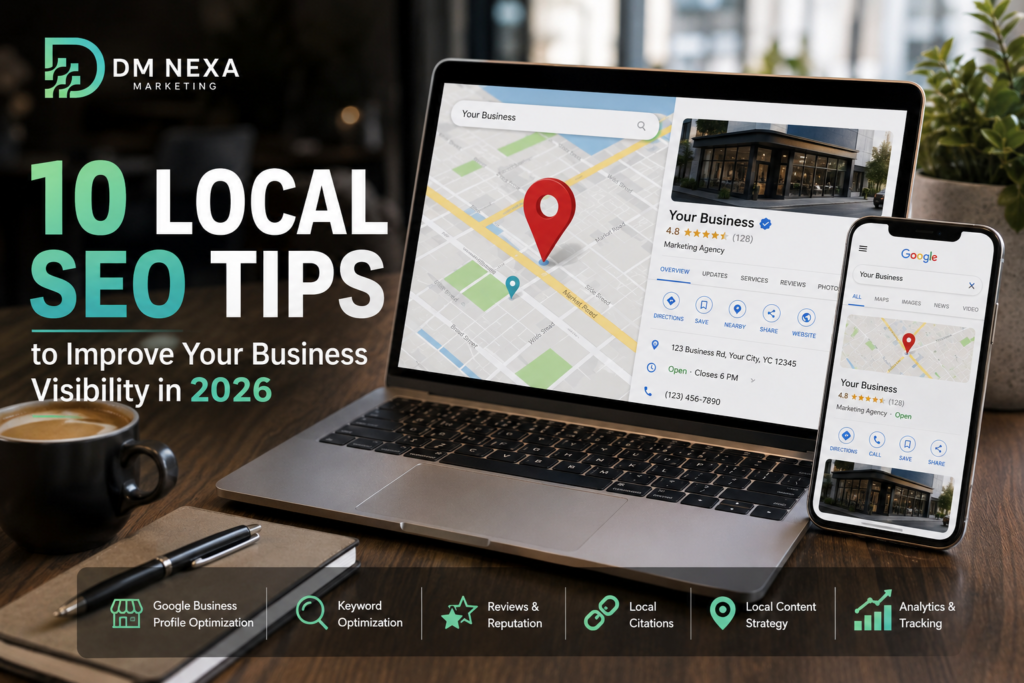
10 Local SEO Tips to Improve Your Business Visibility in 2026
Ask any local business owner where most of their enquiries come from, and you’ll hear a familiar answer: Google.
Whether someone needs a plumber, solicitor, dentist, accountant, or marketing agency, their first instinct is usually to search online. The businesses that appear prominently in those search results tend to get the calls, website visits, and enquiries. The businesses that don’t often struggle to be noticed, regardless of how good their service may be.
That’s why Local SEO has become such an important part of modern marketing.
It’s no longer enough to have a website and hope people find it. Search engines have become far more sophisticated, and competition has increased in almost every industry. If you want your business to stand out in 2026, you need to give Google clear signals about who you are, where you operate, and why your business deserves to be shown to local customers.
The good news is that Local SEO isn’t reserved for large companies with massive marketing budgets. In fact, many smaller businesses have a genuine advantage because they can establish stronger local relevance and build trust within their communities.
Below are ten practical Local SEO tips that can help improve your visibility, strengthen your local presence, and generate more enquiries from people actively searching for the services you offer.
1. Treat Your Google Business Profile Like a Sales Asset
Many businesses claim their Google Business Profile, add a few details, and never look at it again.
That’s a mistake.
For many local searches, your Google Business Profile is more visible than your website. Before someone clicks through to learn more about your business, they’ll often see your reviews, photos, opening hours, contact details, and location directly within Google’s search results.
Think of it as a digital shop window.
An incomplete profile sends the wrong message. A well-maintained profile, on the other hand, reassures potential customers that your business is active, professional, and trustworthy.
Make sure your business information is accurate, upload recent photos, add your services, and keep your opening hours updated. If Google introduces a new feature within the platform, use it. Businesses that actively maintain their profiles tend to outperform those that leave them untouched for months at a time.
2. Make NAP Consistency Non-Negotiable
One of the simplest Local SEO tasks is also one of the most overlooked.
NAP stands for Name, Address, and Phone Number. Search engines use this information to verify that your business is legitimate and operating where it claims to be.
Problems arise when different versions of your details exist across the web. Perhaps your website lists one phone number while an old directory still displays another. Maybe you’ve moved premises and some listings were never updated.
Individually these issues may seem minor. Collectively they can create uncertainty for search engines.
Spend time reviewing your business listings and ensure your information is consistent everywhere. It’s not the most exciting task, but it’s one of the foundations of a strong Local SEO strategy.
3. Focus on Quality Citations Rather Than Quantity
A few years ago, businesses would submit their details to hundreds of directories in the hope of boosting rankings.
Today, that approach offers little value.
Instead, focus on obtaining citations from websites that are credible, relevant, and genuinely useful. A listing on a respected industry directory or local business organisation carries far more weight than dozens of low-quality submissions.
Google isn’t simply counting mentions anymore. It’s evaluating trust.
That means quality local citations remain important, but only when they come from reputable sources.
4. Reviews Influence More Than Customers
Most business owners understand that reviews affect buying decisions. What many don’t realise is how strongly they can influence local visibility as well.
When Google sees a steady flow of genuine customer feedback, it gains confidence that your business is active and serving real customers.
Reviews also provide something that’s increasingly difficult to manufacture online: trust.
Potential customers know every business claims to be reliable. Reviews allow them to hear directly from people who have already used your services.
Rather than asking for reviews occasionally, make it part of your customer journey. A simple follow-up email or text message after completing a job can significantly increase review volume over time.
5. Create Content That Reflects Your Service Areas
One of the biggest mistakes businesses make is publishing content that could belong to any company in any town.
Google is looking for local relevance.
If you serve Cardiff, Swansea, Newport, or Bridgend, your website should reflect that. Discuss local projects, answer questions that local customers commonly ask, and create pages that genuinely help people in the areas you serve.
This isn’t about stuffing location names into every paragraph. It’s about demonstrating local expertise in a way that feels natural and useful.
The more specific and relevant your content becomes, the easier it is for search engines to understand who you serve and where you operate.
6. Don’t Ignore Website Experience
A surprising number of businesses invest heavily in SEO while neglecting the experience visitors have once they arrive on the website.
Traffic alone doesn’t generate enquiries.
If your website loads slowly, looks outdated on mobile devices, or makes it difficult for users to find information, many visitors will leave before taking action.
Google pays close attention to user experience signals. If visitors consistently leave your site without engaging, it sends a message that the experience may not be meeting expectations.
Improving speed, navigation, and usability won’t just help your SEO. It can directly improve conversion rates as well.
7. Build Visibility Beyond Your Website
One of the strongest local ranking signals is authority.
Google wants to recommend businesses that are recognised within their communities.
That means building relationships outside your website can have a meaningful impact on your visibility.
Sponsoring local events, contributing expert commentary to local publications, supporting community initiatives, and collaborating with nearby businesses can all help strengthen your reputation.
These activities often lead to local backlinks, brand mentions, and referral traffic—benefits that extend far beyond SEO alone.
8. Pay Attention to Google Maps
Many business owners focus entirely on traditional search rankings and forget that a large percentage of local searches happen through Google Maps.
Think about your own behaviour.
When searching for a nearby service, you probably look at reviews, locations, and map listings before visiting a website.
Google Maps SEO should therefore be a core part of your Local SEO checklist. Strong reviews, accurate business information, quality citations, and a fully optimised Google Business Profile all contribute to better visibility within map results.
9. Use Local Keywords Naturally
Keyword optimisation still matters, but search engines have become much better at understanding context.
You don’t need to force exact-match phrases into every paragraph.
Instead, focus on writing naturally while covering topics your audience genuinely wants to know about. When your content is relevant and useful, keywords tend to appear organically.
For businesses looking to improve visibility in local search results and attract more qualified enquiries, professional SEO services in Bridgend can provide the expertise and strategic direction needed to achieve sustainable growth.
10. Treat Local SEO as an Ongoing Process
Perhaps the most important tip of all is understanding that Local SEO is never truly finished.
Competitors continue optimising their websites. Google updates its algorithms. Customer behaviour changes. New opportunities emerge.
Businesses that consistently review their performance, refine their strategy, and invest in their online presence are usually the ones that maintain strong local search rankings over the long term.
SEO rewards consistency far more than short bursts of activity.
Final Thoughts
The businesses that perform well in local search aren’t necessarily the largest companies or the ones spending the most money on marketing.
More often, they’re the businesses that consistently get the fundamentals right while investing in Organic SEO Services that support sustainable, long-term growth.
They maintain accurate business information, earn genuine reviews, create useful content, engage with their communities, and continually improve the experience they offer customers online.
Local SEO in 2026 is ultimately about trust. The stronger the signals of trust you provide to both search engines and potential customers, the more visible your business is likely to become.
Whether you’re managing your SEO in-house or working with experienced professionals such as DM Nexa Marketing, focusing on these core principles will put your business in a stronger position to improve its local visibility and attract more qualified customers.
Focus on that principle, and many of the ranking improvements you’re looking for will naturally follow.
More Posts